
SI Joint Pain Treatment: Clinician Plan Starts With Six Months' Rehab


Most sacroiliac joint pain treatment follows the same evidence-backed sequence: conservative care first, image-guided injections and radiofrequency ablation for pain that persists, and minimally invasive fusion only when everything else has been given a fair trial. The encouraging part is that a large share of patients feel meaningfully better within weeks to a few months once their conservative care plan is actually optimized, not just started and abandoned.
TL;DR:
Most sacroiliac joint pain resolves with conservative management, including medication, movement, and physical therapy, before considering injections or surgery.
Diagnostic confirmation through image-guided local anesthetic blocks is essential to accurately identify the SI joint as the pain source and improve treatment success.
Physical therapy focused on restoring joint mobility, correcting biomechanical faults, and strengthening gluteal and core muscles yields the best long-term outcomes.
Injections guided by imaging serve both diagnostic and therapeutic purposes, with corticosteroid options providing weeks to months of relief, and repeat procedures are common.
Surgery is a last resort, typically after six months of optimized conservative care and confirmed diagnostic injection relief, with outcomes still showing mixed long-term benefits.
Table of Contents
How Do Doctors Diagnose SI Joint Pain?
The sacroiliac joint has a frustrating reputation among clinicians: it mimics low back pain, hip pain, and even sciatica so convincingly that diagnosis often takes longer than it should. Patients typically describe a dull, one-sided ache below the belt line, sometimes radiating into the buttock or upper thigh, that worsens with prolonged sitting, climbing stairs, or rolling over in bed. That pattern, on its own, is a clue, not a diagnosis.
We rely on a cluster of physical exam maneuvers called provocation tests to narrow things down. These include:
The FABER test (flexion, abduction, external rotation of the hip)
Thigh thrust
Compression and distraction tests
Gaenslen’s test
The sacral thrust
No single test is reliable enough to stand alone. Clinical guidance generally treats a cluster of three or more positive provocation tests as meaningfully increasing the likelihood that the SI joint is the actual pain generator, rather than a bystander joint aggravated by something else.
Imaging plays a supporting role, not a starring one. Plain X-rays and MRI rarely show anything definitive in mechanical SI joint pain because the joint often looks structurally normal even when it hurts. Where imaging earns its keep is ruling out inflammatory causes, such as ankylosing spondylitis or sacroiliitis linked to autoimmune disease, where MRI can reveal bone marrow edema and joint changes that redirect the entire treatment plan toward rheumatology rather than orthopedics.
The diagnostic gold standard is the image-guided local anesthetic block. A clinician injects numbing medication directly into the joint under CT, fluoroscopic, or ultrasound guidance, then asks the patient to repeat whatever activity typically triggers their pain. If the patient reports at least roughly 50% relief from that single injection, the SI joint is confirmed as a real contributor to the pain, and treatment can be targeted with far more confidence. This step matters more than most patients realize. Skipping it and jumping straight to injections, ablation, or surgery based on symptoms alone is one of the most common reasons those treatments underperform.
What Is First-Line Treatment for SI Joint Pain?
Conservative care is where nearly every SI joint pain treatment plan starts, and for good reason: it resolves acute pain for the majority of patients without ever requiring a needle or a scalpel. Guideline authors specifically recommend optimizing conservative therapy for at least six months before fusion surgery even enters the conversation.
Statistic Callout: Conservative, non-surgical management is considered the foundational first-line treatment for SI joint pain, and most acute cases resolve with these measures alone, without ever needing an injection or procedure.
Medications, used carefully
NSAIDs like ibuprofen or naproxen and acetaminophen remain the first medication choice for most adults with SI joint pain, largely because they address inflammation and discomfort without the dependency risks of opioids. They are not risk-free, though. NSAIDs carry real cautions for anyone with a history of kidney disease, stomach ulcers, or cardiovascular disease, and long-term daily use should always be discussed with a physician rather than self-managed indefinitely. Acetaminophen is gentler on the stomach and kidneys but has its own ceiling, particularly for people with liver conditions or heavy alcohol use.
Movement, not bed rest
Here is where a lot of well-meaning advice goes wrong. In the first day or two of a severe flare, brief rest and activity avoidance make sense. Beyond that window, prolonged bed rest actively works against recovery. It weakens the core and gluteal muscles that stabilize the pelvis in the first place, which often makes the next flare worse. Guided, early mobilization, starting with short walks and gentle range-of-motion work, tends to outperform extended rest for restoring function.
Pelvic belts and external supports
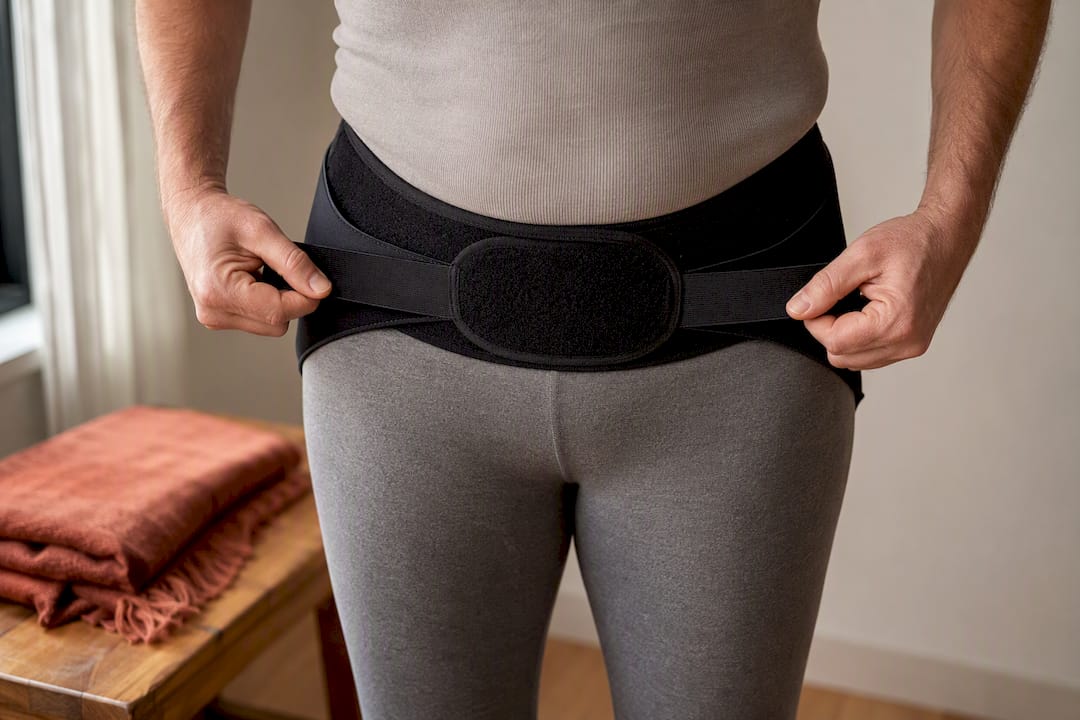
A sacroiliac belt, worn snugly around the hips just below the waist, compresses the joint and can reduce the micromotion that aggravates pain. The evidence here is strongest for a specific population: peripartum patients, whose ligaments loosen from hormonal changes during pregnancy and who often get real relief from external stabilization while their bodies recover. Belts are a supplement to an active recovery plan, not a substitute for one.
How long to try conservative care before escalating
A reasonable trial runs anywhere from six to twelve weeks of consistent activity modification, medication as needed, and physical therapy before judging whether it’s working. The six-month optimization window referenced in current guidelines is not a mandate to suffer silently for half a year. It is a floor for surgical consideration, not a floor for every intervention. If diagnostic uncertainty remains high or pain is severe and clearly refractory, an earlier diagnostic block or injection can be appropriate. The point of the six-month benchmark is to prevent premature fusion, not to delay all relief.
What Does SI Joint Physical Therapy Involve?
Physical therapy is the backbone of long-term SI joint pain relief, and it works best when it targets the actual mechanical problem rather than offering generic stretches. A well-built program usually has three goals: restore normal joint mobility, correct the biomechanical faults (often a weak glute medius or an asymmetric pelvis) that caused the overload in the first place, and build enough core, gluteal, and pelvic floor strength to keep the joint stable under daily stress.
A typical progression looks something like this:
Pain-calming phase: gentle pelvic tilts, breathing work, and joint mobilization to reduce guarding
Motor control phase: exercises that retrain the deep core and pelvic floor to fire correctly during movement
Strengthening phase: glute bridges, clamshells, and hip abduction work to build load tolerance
Functional phase: single-leg balance drills, step-ups, and sport- or work-specific movement patterns
The research is fairly consistent on one point: combining manual therapy with a structured exercise program outperforms exercise alone for longer-term physical and social functioning. Hands-on joint mobilization seems to reduce pain enough to let patients actually do the strengthening work that produces lasting change, and randomized evidence backs this combined approach over either strategy in isolation.
Pro Tip: Ask any physical therapist you’re considering how they measure progress. A program with no individualized plan, no reassessment every few weeks, and no clear progression from one phase to the next is a red flag, regardless of how confident the pitch sounds.
Choosing a physical therapist for SI joint pain physical therapy usually comes down to fit and consistency more than credentials alone. Look for someone who reassesses your movement patterns every two to four weeks and adjusts the plan accordingly, rather than handing you the same sheet of exercises at every visit. A rehabilitation program built around progressive loading tends to produce steadier gains than one that stays static for months.
When Should You Get an Injection for SI Joint Pain?
Injections serve two distinct purposes in sacroiliac joint therapy, and mixing them up leads to confusion about what to expect. A diagnostic block, described earlier, uses local anesthetic alone to confirm the joint as the pain source. A therapeutic injection adds corticosteroid to that anesthetic, aiming for weeks to months of reduced inflammation and pain.
Intra-articular injections place medication directly inside the joint capsule, guided by imaging to hit the small, irregularly shaped joint space accurately.
Extra-articular injections target the ligaments and soft tissue surrounding the joint, which matters because a meaningful share of SI joint pain originates outside the joint capsule itself, in the posterior ligaments and surrounding structures rather than the cartilage.
Imaging guidance (CT, fluoroscopy, or ultrasound) substantially improves needle placement accuracy compared with blind injection, and CT and fluoroscopy generally lead in precision, with ultrasound as a reasonable alternative when radiation exposure is a concern.
Statistic Callout: Image-guided injection is recognized as the diagnostic gold standard for confirming SI joint dysfunction, serving both as a test and, with corticosteroid added, as a treatment in the same procedure.
Regenerative options like platelet-rich plasma (PRP) and bone marrow aspirate concentrate (BMAC) have entered the conversation as alternatives to steroid injections, particularly for patients who respond well initially but see relief fade quickly. The evidence base for these is still developing, and typical candidates tend to be younger patients with ligamentous laxity rather than degenerative joint changes. Contraindications for any SI joint injection include active infection near the injection site, uncontrolled bleeding disorders, and pregnancy considerations that require extra caution around imaging and medication choice.
What Is Radiofrequency Ablation for SI Joint Pain?
Radiofrequency ablation (RFA) targets the small sensory nerves, mainly the lateral sacral branches and sometimes contributions from L4 to L5, that carry pain signals from the SI joint without disrupting the joint’s structure. Three main techniques exist: conventional RFA, which heats the nerve directly; cooled RFA, which creates a larger, more consistent lesion by keeping the electrode tip cool during treatment; and pulsed RFA, a gentler option that delivers energy in bursts rather than continuous heat.
RFA is only considered after diagnostic lateral-branch blocks confirm the nerve pathway, typically requiring about 50% pain relief from that block before proceeding.
Relief from a successful RFA procedure commonly lasts nine to eighteen months, though this varies by technique and individual anatomy.
Repeat procedures are common once relief fades, since the nerve pathways can regenerate over time.
Risks are generally low but include temporary numbness, bruising, and rare cases of incomplete relief if the nerve anatomy doesn’t match the targeted branches precisely.
Set expectations honestly here: RFA is a strong option for pain reduction, not a permanent cure. Patients who understand it as a repeatable tool rather than a one-time fix tend to plan their long-term care more realistically.
When Is Surgery Necessary for SI Joint Pain?
Minimally invasive SI joint fusion is the last stop on the treatment ladder, not an early option. Candidacy generally requires persistent pain despite optimized conservative care, typically for six months or longer, plus diagnostic confirmation through an image-guided injection showing the joint is truly the pain source. Surgery undertaken without that diagnostic confirmation is discouraged precisely because SI joint symptoms overlap so heavily with other back and hip conditions.
Common approaches include lateral implant placement and posterior fixation techniques, each with different recovery timelines and implant designs.
Evidence shows improvement in pain and function for some patients, though long-term outcomes and whether fusion outperforms continued conservative management remain genuinely mixed in the research.
Complication and reoperation rates are meaningful enough that surgeons discuss them candidly during consultation; this is not a procedure with a guaranteed clean recovery.
Insurance carriers frequently require documented relief thresholds from prior diagnostic injections before authorizing fusion, which is another reason the diagnostic block step cannot be skipped.
How Long Does SI Joint Pain Take to Heal?
Days 1 to 3 (acute phase): Rest, ice, and activity avoidance for the sharpest pain, without extending bed rest beyond this window.
Days 3 to roughly 8 weeks (subacute phase): Shift toward physical therapy, guided mobility, and gradual return to normal movement.
Months 2 through 6 (persistent phase): Continue optimizing conservative care, medication, PT, and possibly a diagnostic or therapeutic injection if progress stalls.
Beyond 6 months (chronic/refractory phase): Consider RFA if diagnostic blocks confirm a nerve target, or fusion if conservative care and less invasive procedures have genuinely been exhausted.
Some patients need to skip ahead of this timeline, and that’s appropriate when diagnostic uncertainty remains high or pain is severe enough to disrupt daily function early on. Seek urgent evaluation regardless of timeline if you notice new numbness or weakness in the legs, changes in bowel or bladder control, or severe pain that doesn’t ease at all with rest, since those symptoms point to something beyond ordinary SI joint dysfunction.
How Do You Manage an SI Joint Pain Flare at Home?
A flare feels like a setback, but most respond well to a short, structured self-care window while you arrange professional care. Sleep position matters more than people expect: lying on your back with a pillow under your knees, or on your side with a pillow between your knees, keeps the pelvis level and reduces overnight strain on the joint.
For the first 48 hours of an acute flare, ice calms inflammation more effectively than heat. After that window, if the area feels tight and stiff rather than acutely inflamed, heat tends to help more by relaxing the surrounding muscles. Walking is not the enemy here. Gentle, progressively longer walks support recovery far better than staying immobile, as long as you’re not pushing through sharp pain.
Avoid prolonged sitting, heavy lifting, and twisting motions like reaching across your body while seated, since all three load the joint asymmetrically. Pacing matters: break up sitting every 30 minutes, and resist the urge to “push through” a good day by doing everything you’ve been avoiding.
Pelvic tilts, done slowly and gently, ten repetitions twice daily
Standing hip abduction holds against a wall for pelvic stabilization
Slow, controlled knee-to-chest stretches, avoiding any bounce
Pro Tip: If a home exercise reproduces your usual SI joint pain rather than a mild stretch sensation, stop and swap it for a gentler variation. Pain during movement is your body’s signal to scale back, not push through.
These three movements maintain mobility between appointments; they are not a replacement for a structured physical therapy program built around your specific mechanical pattern.
How Compassion Chiropractic Approaches SI Joint Pain
A chiropractic care model that emphasizes hands-on assessment aims to identify biomechanical patterns behind pain, building a plan around manual adjustments and progressive rehabilitation rather than a one-size-fits-all routine.
Personalized chiropractic adjustments aimed at restoring joint mobility and reducing pelvic asymmetry
Guided rehabilitation and stretching programs that build core and gluteal strength over time
Electrotherapy and other holistic modalities to support pain management alongside active care
A walk-in model that removes the wait time often attached to starting conservative care
Combining manual therapy with a progressive strengthening plan is exactly the pathway that current evidence favors over passive treatment alone. When a patient’s pain pattern suggests something beyond what conservative chiropractic care can address, we coordinate referral to appropriate specialists for imaging or injection-based evaluation, because getting the right diagnosis matters more than getting a quick answer.
A Clinician’s View on What Actually Moves the Needle
The biggest gap I see between what patients expect and what actually works is patience with the process. Conservative care isn’t a placeholder while you wait for the “real” treatment. For most people, it is the real treatment, and abandoning it after two weeks because the pain hasn’t vanished is the single most common reason recovery stalls.
Improvement with SI joint pain is rarely linear. Expect good weeks and frustrating ones, and expect that some patients genuinely need to progress toward injections or RFA, which is not a failure of conservative care but a normal part of a staged approach. If you’re ever considering an advanced intervention, make sure whoever is guiding your conservative care and whoever performs the procedure are actually talking to each other. Fragmented care is where good outcomes go to die.
— James
Ready to Start Treating SI Joint Pain the Right Way?
An assessment-first approach that identifies underlying causes of SI joint pain, then builds hands-on care and progressive rehabilitation around it, can be offered with pricing structured to stay accessible rather than locked behind long-term contracts.

A walk-in model can reduce wait times for an initial evaluation. Bringing symptom history and prior imaging or injection records can help speed assessment. When cases require steps beyond conservative care, coordinating referrals for diagnostic blocks or advanced imaging supports appropriate treatment pathways. For readers managing a flare right now, pairing active recovery pacing strategies with in-clinic care tends to produce steadier progress than either alone.
Ready to get started? Book your visit online or stop in for a walk-in assessment, no long wait, no pressure, just a clear plan for your SI joint pain.
Where This Guide’s Evidence Comes From
NYSORA global guidelines: current consensus recommendations on staged SI joint treatment
StatPearls (NCBI): clinical overview of diagnosis and image-guided injection technique
AAFP clinical review: evidence on combined manual therapy and exercise outcomes
ASPN best practice guideline: neuroablative technique criteria and diagnostic thresholds
PMC review and algorithm: surgical candidacy and outcomes evidence for SIJ fusion
Sources
FAQ
What Is the Best Sleeping Position for SI Joint Pain?
Sleeping on your back with a pillow under your knees, or on your side with a pillow between your knees, keeps the pelvis level and reduces nighttime strain on the joint.
How Do You Loosen a Locked SI Joint?
Gentle pelvic tilts, hip abduction holds, and slow knee-to-chest stretches can ease a stiff or locked-feeling SI joint, though a chiropractic adjustment or physical therapy session addresses the underlying mechanical restriction more directly.
Does Walking Help SI Joint Pain?
Yes. Gentle, progressively longer walks generally support recovery better than staying immobile, as long as the pace and distance don’t reproduce sharp pain.
What Should You Avoid With SI Joint Dysfunction?
Avoid prolonged bed rest, heavy lifting, and twisting motions like reaching across your body while seated, since these patterns load the joint unevenly and tend to prolong flares.
How Long Should You Try Conservative Care Before Considering Surgery?
Guidelines generally recommend optimizing conservative treatment, including medication, activity modification, and physical therapy, for at least six months before minimally invasive SI joint fusion is considered.
Recommended
Comments