
12 Week Omega 3 Trial for Joint Pain: When 2.7 g/day Helps
- Bill Smith
- 23 hours ago
- 12 min read


Omega-3 supplements offer real but modest relief for inflammatory joint conditions like rheumatoid arthritis, with meta-analyses showing measurable drops in pain and morning stiffness after about three months of consistent, higher-dose use. For osteoarthritis or mechanical knee pain, the evidence is weaker and sometimes flat. Benefits depend on getting enough EPA and DHA, not just any fish oil bottle, and we always encourage you to loop your doctor or chiropractor into the plan before ramping up your dose.
TL;DR:
Omega-3s show modest benefits for rheumatoid arthritis after at least three months of high-dose use, mainly reducing morning stiffness and tender joints.
Effective doses typically range from 1 to 3 grams of EPA and DHA daily, which means consuming multiple capsules or choosing concentrated formulas to meet thresholds.
Omega-3s work by reducing systemic inflammation through incorporation into cell membranes, lowering inflammatory signaling molecules, and promoting inflammation-resolving compounds.
They are less likely to help osteoarthritis or mechanical knee pain, which are caused by structural issues rather than systemic inflammation.
Use caution with high doses, check for third-party testing, and always consult a healthcare professional before adjusting doses, especially if on blood thinners or with allergies.
Table of Contents
What Does the Research Say About Omega-3 for Joint Pain?
The clearest signal in the research points toward inflammatory joint disease, not degenerative wear and tear. That distinction shapes almost everything else in this guide, so it’s worth sitting with for a moment before we get into numbers.
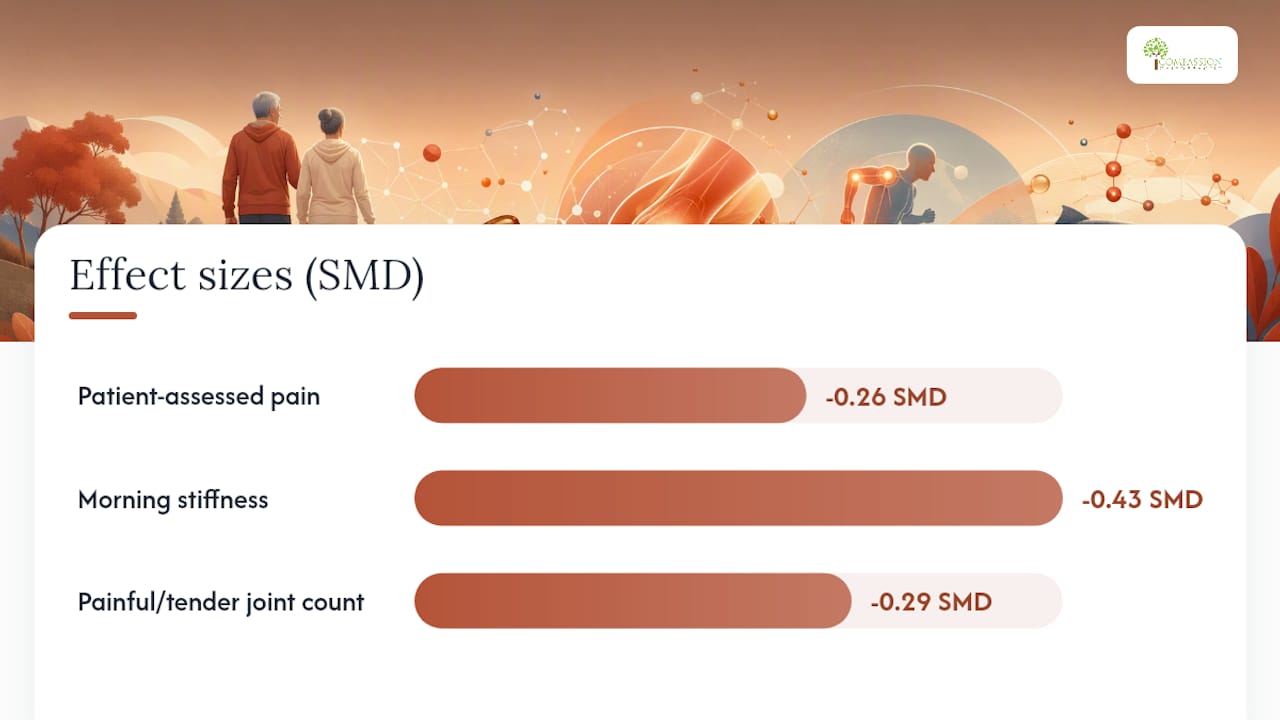
A well-regarded review pooled data from over a dozen randomized trials and found that long-chain omega-3 supplementation, taken for at least three months, improved several measures that matter most to people living with joint pain. Patient-assessed pain improved with a standardized mean difference of -0.26 across 13 trials involving 501 people. Morning stiffness showed a bigger shift, at -0.43 across 8 trials. The count of painful or tender joints dropped with an SMD of -0.29 across 10 trials covering 425 patients.
Those numbers won’t wow anyone looking for a miracle fix, and they shouldn’t. Standardized mean differences in that range represent a modest but real effect, roughly on par with what some people get from mild-to-moderate doses of over-the-counter anti-inflammatory medication, minus the stomach lining risk. Mayo Clinic’s own guidance echoes this: fish oil may reduce pain and improve morning stiffness and joint tenderness specifically in rheumatoid arthritis, and it may even lower how much anti-inflammatory medication someone needs day to day.
Statistic Callout: In the strongest available meta-analysis, morning stiffness improved nearly twice as much as general pain scores (SMD -0.43 vs. -0.26), suggesting omega-3s may work best on the inflammatory “creakiness” of joints rather than raw pain intensity alone.
Randomized controlled trials paint a more textured picture once you separate them by condition.
Rheumatoid arthritis trials using higher EPA+DHA doses consistently showed symptom improvement, though it typically took two to three months to show up.
Trials in general aging populations with chronic knee pain, most notably a VITAL-related subgroup analysis of nearly 1,400 older adults, found no significant difference in WOMAC pain, function, or stiffness scores between omega-3 and placebo groups over more than five years.
Comparator choice matters. Several trials used olive oil as the placebo, and olive oil itself carries mild anti-inflammatory compounds, which may have narrowed the apparent gap between treatment and placebo groups.
Sample sizes in some of the positive RA trials were small enough that a handful of high responders can shift the average, which is part of why reviewers describe the evidence as “modest” rather than “strong.”
That heterogeneity, different populations, different doses, different comparator oils, different trial lengths, is exactly why you’ll see headlines that seem to contradict each other. One article says fish oil eases arthritis pain; another says it does nothing for knee pain. Both can be true at once, because they’re often describing two different diseases wearing the same symptom.
Which Omega-3 Molecules and What Dose Actually Matter?
Not all omega-3s are created equal, and this is where a lot of well-meaning supplement shopping goes wrong. EPA (eicosapentaenoic acid) and DHA (docosahexaenoic acid) are the long-chain omega-3s that show up in joint-pain trials. ALA (alpha-linolenic acid), the plant-based omega-3 found in flaxseed and walnuts, has to convert into EPA and DHA inside your body, and that conversion is inefficient. ALA hasn’t been studied nearly as directly for joint outcomes, so it shouldn’t be your primary strategy if joint pain is the target.
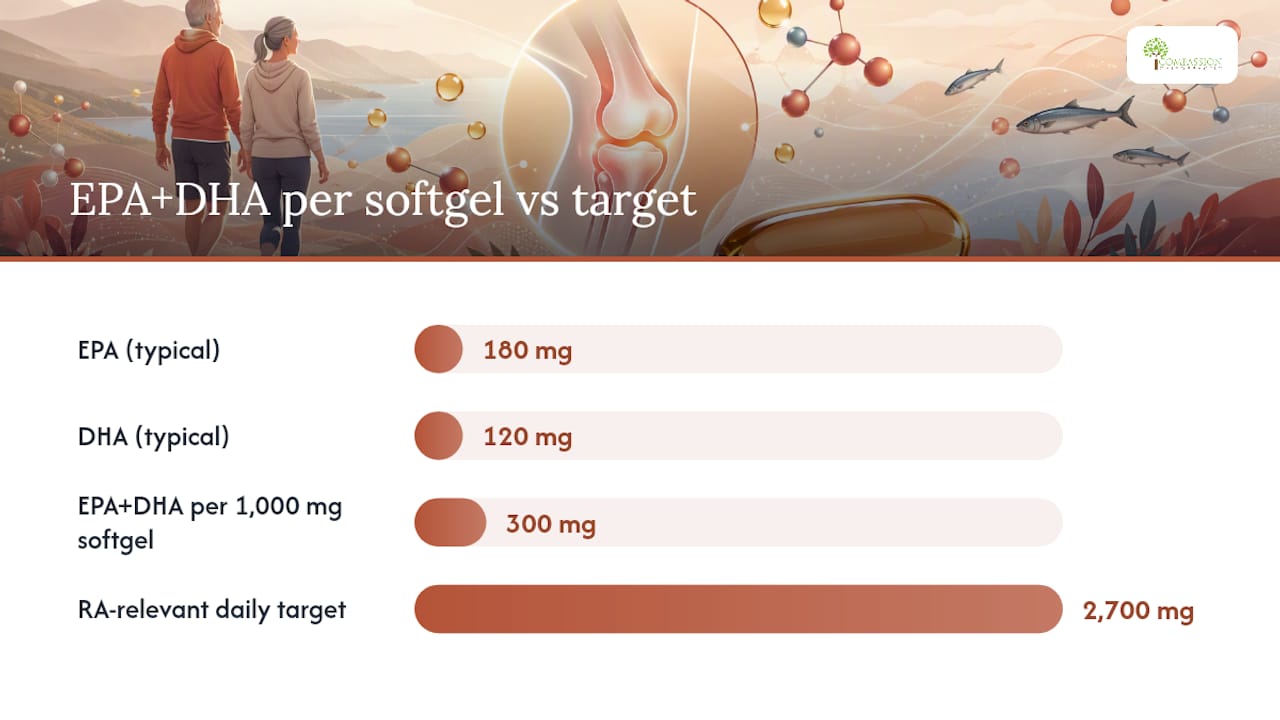
Here’s the part that trips up most shoppers: the number on the front of the bottle usually refers to total fish oil weight, not the active EPA+DHA content. According to the NIH Office of Dietary Supplements, a typical 1,000 mg fish oil softgel delivers roughly 180 mg EPA and 120 mg DHA, meaning around 300 mg of the ingredients that actually matter for inflammation. The rest is other fats and fillers.
Trial-backed dosing tends to cluster in a specific range:
General anti-inflammatory support: many trials use 1 to 3 grams per day of combined EPA+DHA.
Rheumatoid arthritis symptom relief: benefit signals frequently appear at or above about 2.7 grams per day of EPA+DHA, sustained for two to three months.
Basic OTC softgels at ~300 mg EPA+DHA per capsule would require nine or more capsules daily to hit that RA-relevant threshold, which is neither realistic nor comfortable for most people.
Pro Tip: Flip the bottle over and find the “Supplement Facts” panel, not the front label. Add up EPA and DHA specifically, per serving, then multiply by however many servings you’d need to reach your target. If the math requires a fistful of capsules, look for a concentrated formula instead.
How Do Omega-3s Actually Reduce Joint Inflammation?
The biology behind these numbers gives the clinical findings some real credibility, and it helps explain why the effect looks so different across conditions.
Cell membranes throughout your body incorporate whatever fatty acids you feed them. When you consistently supply EPA and DHA, they get built into the membranes of cells involved in the inflammatory response, partially displacing arachidonic acid (AA), an omega-6 fatty acid that serves as the raw material for many proinflammatory prostaglandins and leukotrienes. Less AA available means fewer of those inflammatory signaling molecules get produced when your immune system activates.
EPA and DHA also serve as building blocks for resolvins and protectins, specialized molecules your body uses to actively wind down inflammation once it’s done its job, rather than simply blocking inflammation from starting. That’s a meaningfully different mechanism than a typical anti-inflammatory drug.
Clinical trials back this up at the blood-marker level. A systematic review pooling 96 clinical trials found consistent reductions in CRP, IL-6, and TNF-alpha, three of the most-watched inflammatory markers in medicine, associated with EPA+DHA doses in the 1 to 3 gram range. Those markers matter because they’re upstream drivers of the joint swelling and stiffness that rheumatoid arthritis patients feel every morning.
Here’s the caveat worth sitting with: this mechanism targets systemic inflammation. It doesn’t repair worn cartilage, rebuild joint space, or reverse mechanical damage. That’s likely a big part of why omega-3s help RA more reliably than osteoarthritis. One condition is fundamentally an inflammatory disease; the other is often, though not always, a structural and mechanical one.
Who Actually Benefits: Inflammatory vs. Degenerative Joint Pain?
If you take away one thing from this guide, make it this: your diagnosis matters more than your dose.
People with rheumatoid arthritis and related inflammatory arthritis conditions see the most consistent, reproducible benefit across the research. The mechanism lines up with the disease process, the RCTs show real symptom movement, and both Mayo Clinic and the meta-analytic literature support cautious optimism here, particularly for pain, stiffness, and tender joint counts after a few months of adequate dosing.
People with osteoarthritis or general mechanical knee pain should set expectations lower. The VITAL-related trial found no meaningful difference in knee pain, function, or stiffness scores over more than five years of follow-up, even in a large, well-designed study population. If your joint pain comes from cartilage wear, old injury, or biomechanical stress rather than systemic inflammation, omega-3s are less likely to move the needle on their own.
A few practical signs can help you sort which camp you’re likely in, though only a clinician can actually diagnose it:
Inflammatory pain often comes with prolonged morning stiffness (30+ minutes), symmetrical joint involvement, warmth or visible swelling, and improvement with movement throughout the day.
Mechanical or degenerative pain tends to worsen with activity and weight-bearing, improve with rest, and stay localized to one or two joints without much morning stiffness.
Overlap is common. Plenty of people have some combination of both, especially as they age.
If you’re not sure which pattern fits you, that’s a conversation for your primary care provider or a chiropractor experienced in joint assessment, not a guessing game with supplement bottles.
Is Omega-3 Safe? Side Effects and Interactions to Watch
Most people tolerate omega-3 supplements reasonably well, but “well tolerated” doesn’t mean “risk-free,” especially at the higher therapeutic doses used in the RA trials.
The most common complaints are mild and mostly annoying rather than dangerous: fishy aftertaste, burping, and general gastrointestinal upset like loose stools or bloating. Taking supplements with food, splitting the dose, or freezing softgels can reduce these effects for a lot of people.
Prescription-strength omega-3 formulations, which deliver much higher concentrations than typical OTC softgels, carry a different and slightly more serious side effect profile. Documented adverse reactions include joint pain (arthralgia, ironically) and elevated liver enzymes (ALT/AST) in some patients, which is one more reason prescription-dose omega-3 therapy belongs under a doctor’s supervision rather than a self-directed supplement aisle experiment.
Statistic Callout: Reaching the RA-relevant dose of roughly 2.7 g/day EPA+DHA from a standard OTC softgel (about 300 mg EPA+DHA each) would take nine or more capsules daily, a volume that pushes most people toward concentrated formulas or medical guidance rather than the drugstore bottle.
A few interaction and quality points deserve your attention before you start:
Blood thinners and antiplatelet drugs: Omega-3s have mild antiplatelet effects of their own. Combining high doses with warfarin, aspirin, or similar medications can raise bleeding risk, so this combination needs clinician sign-off.
Fish allergies: People with fish or shellfish allergies should choose algal-oil formulas instead of fish-derived products, and still discuss it with a doctor first.
Oxidized or spoiled oils: Fish oil goes rancid faster than most supplements. A strongly fishy smell (more than the usual mild odor) or an unpleasant aftertaste that lingers can signal oxidation, which reduces effectiveness and may irritate your gut further.
Contaminants: Mercury and PCBs can concentrate in fish-derived oils. Third-party testing (look for seals from established testing organizations) helps confirm a product has been screened for these.
Warning signs to stop and call your doctor: unexplained bruising, unusual bleeding, dark urine, yellowing skin or eyes, or new abdominal pain warrant stopping the supplement and getting evaluated promptly.
Food vs. Supplements: How Should You Get Your Omega-3s?
Mayo Clinic’s guidance leans firmly toward food first, and that’s sound advice for most people, not just a feel-good platitude. Fatty fish like salmon, mackerel, sardines, and anchovies deliver EPA and DHA in a form your body handles well, alongside protein, vitamin D, and other nutrients that supplements can’t replicate. For people who don’t eat fish, algal oil delivers the same EPA and DHA without the fish, making it a solid vegetarian and vegan option.
Supplements earn their place when diet alone can’t realistically hit therapeutic levels, particularly for rheumatoid arthritis under a clinician’s guidance, for people with elevated triglycerides, or for anyone who simply doesn’t eat oily fish more than once a week.
When you do shop for a supplement, work through this quickly:
Find EPA+DHA per serving, not the total fish oil milligram count on the front label.
Check servings per container against the number of capsules you’d actually need daily to hit your target dose.
Compare concentrate formulas to standard fish oil. A concentrated triglyceride or ethyl ester formula packs more EPA+DHA per capsule, meaning fewer pills for the same dose.
Look for a third-party testing seal confirming the product has been checked for potency and contaminants like mercury or PCBs.
Pro Tip: Store fish oil supplements in the refrigerator once opened. Cool storage slows oxidation and helps you avoid the rancid taste that often makes people quit a supplement before it’s had time to work.
How Do You Trial Omega-3 Safely and Know If It’s Working?
Guesswork is the enemy of a fair trial. Most people who say “fish oil didn’t work for me” either underdosed, quit too early, or never tracked anything to compare against. Here’s a structure that avoids all three problems.
Pick your target dose based on your goal. General anti-inflammatory support usually falls in the 1 to 3 gram EPA+DHA per day range; if you’re specifically managing rheumatoid arthritis symptoms, RA trials point toward roughly 2.7 grams per day as the threshold where benefits become more consistent.
Calculate your capsule count using EPA+DHA totals, not total fish oil weight, referencing the label math covered earlier.
Record your baseline before you start: a simple 0 to 10 pain scale, minutes of morning stiffness, and how often you’re reaching for over-the-counter pain relievers.
Commit to a minimum of 8 to 12 weeks, ideally the full 12, before judging results. RA trials showed benefit emerging at the two to three month mark, not week two.
Reassess using the same three metrics every few weeks so you’re comparing apples to apples instead of relying on memory.
If nothing has shifted after a genuinely well-dosed 12-week trial, that’s useful information, not failure. Bring it to your clinician and discuss next steps: prescription-strength omega-3 formulations, medication adjustments, or hands-on rehabilitative therapies.
Pro Tip: Keep a simple note on your phone with the date you started, your target dose, and your baseline numbers. Twelve weeks from now, “I think it’s a little better” is a lot less useful than “stiffness dropped from 45 minutes to 20.”
For readers exploring nonpharmacologic paths alongside supplementation, Clinica Orto Oxacell’s overview of nonpharmacologic osteoarthritis treatments offers additional context on options beyond the pill bottle.
How Does a Chiropractic Care Team View Omega-3 Supplementation?
At Compassion Chiropractic, we think of nutrition as one piece of a bigger puzzle, never the whole picture. Omega-3s can support the body’s own anti-inflammatory processes, but they work best alongside hands-on care that addresses the mechanical side of joint pain too, things like restricted mobility, muscular imbalance, and postural strain that no supplement touches.
Since our founding in 2009, we’ve built our walk-in model around getting people evaluated quickly, without the wait that often delays care for weeks. When a patient mentions they’re considering fish oil or already taking it for joint pain, we encourage discussing dosing with their primary care provider, especially if they’re on blood thinners, while we focus on what we do best: chiropractic adjustment, rehabilitation, and modalities like infrared sauna or cold plunge that support the body’s healing capacity from a different angle. Nutrition and hands-on care aren’t competing strategies. They work better together.
What Should You Actually Prioritize First?
Here’s where we’ll be blunt: a lot of joint-pain content online treats omega-3 as either a miracle or a myth, and neither framing serves you. The honest read of the evidence is narrower and more useful than either extreme. If you have rheumatoid arthritis or a confirmed inflammatory condition, the data supports a real, if modest, trial of adequately dosed EPA+DHA. If your pain is mechanical, osteoarthritic, or you’re not sure which camp you fall into, supplement first and diagnose later is backwards.
What gets underestimated most is dose. Most people who tried fish oil and gave up were likely taking a fraction of the amount used in the trials that actually showed benefit. That’s not a failure of omega-3s; it’s a failure of label math.
Prioritize getting an accurate diagnosis before you prioritize a supplement regimen. Then, if omega-3 fits your case, dose it properly, track it honestly, and give it the 12 weeks trials suggest it needs.
— James
Compassion Chiropractic: Support for Joint Pain Beyond the Supplement Aisle
Omega-3s can take the edge off systemic inflammation, but they can’t loosen a stiff hip, correct a shifted spine, or rebuild the mobility you’ve lost to months of guarding a sore knee. Compassion Chiropractic exists for the mechanical half of joint pain that a bottle of fish oil was never designed to solve, and we do it on a walk-in basis so you’re not stuck waiting weeks for an appointment while your pain sits untouched.

A first visit typically starts with an assessment focused on your specific pain pattern, whether that’s inflammatory stiffness, mechanical wear, or a mix of both, followed by a personalized plan that might include chiropractic adjustment, rehabilitation exercises, or supportive modalities like nutritional therapy if your team decides diet is part of the equation. Our fee-for-service model includes a donation option for patients who need it, because affordable access to care shouldn’t depend on your insurance situation.
If you’re already trialing omega-3s for joint pain and want a hands-on evaluation to complement that plan, book your visit online and walk in ready to get assessed.
This article is general information, not a substitute for advice from a qualified doctor. Consult a qualified healthcare professional about your own circumstances before acting on anything here.
Sources
Recommended
Comments