
48–72 Hour Cold Plunge for Inflammation: Clinician Care for Athletes

Cold plunges do reduce short-term inflammation markers and take the edge off muscle soreness, but the benefit is modest and depends heavily on timing. Immediate cold numbs pain and calms early inflammatory signals like IL-6, while whole-body cryotherapy shows stronger effects on creatine kinase and C-reactive protein a few days later. If you’re chasing muscle growth, dunking right after a lifting session can blunt the very adaptation you trained for. Used thoughtfully, and with a doctor’s clearance if you have heart or circulation concerns, a short, controlled cold plunge is a genuinely useful recovery tool. Used carelessly, it’s just cold water.
TL;DR:
Cold water immersion provides immediate pain relief by numbing nerves, but its effect on reducing inflammation markers is modest and depends on timing.
Cold plunges are most effective within 48 to 72 hours post-exercise for addressing delayed muscle soreness, with cryotherapy showing stronger effects on markers later.
For muscle growth, delaying cold exposure by three to four hours after resistance training prevents blunting key inflammatory signaling that promotes hypertrophy.
Cold therapy is safest when kept above 39°F (4°C), with sessions lasting under 20 minutes, and should be avoided by individuals with cardiovascular risks without medical clearance.
Supervised cold plunge sessions in clinical settings improve safety, allow tailored protocols, and support recovery from injuries or chronic inflammation more effectively than at-home use.
Table of Contents
What Does the Research Say About Cold Plunges and Inflammation?
Safe Cold Plunge Protocols: Temperature, Duration, and Timing
Who Should Avoid Cold Plunges or Get Medical Clearance First?
How to Use Cold Plunges for Recovery, Injury, and Chronic Inflammation
How Chirocompassion Approaches Cold Plunge in a Recovery Plan
What Is a Cold Plunge and How Does It Affect Inflammation?
A cold plunge, also called cold water immersion (CWI), means submerging some or all of your body in water at a cool temperature range considered effective for recovery, typically for a short period after exercise or injury. Whole body cryotherapy (WBC) is a related but distinct approach that uses extremely cold air rather than water, usually for two to four minutes in an enclosed chamber. Both fall under the broader umbrella of cold therapy, and both are frequently lumped together in casual conversation even though they act on the body somewhat differently.
At the physiological level, cold triggers vasoconstriction, meaning your blood vessels narrow to conserve core heat. This slows blood flow to the skin and underlying tissue, which is part of why swelling can look reduced right after a plunge. Lower tissue temperature also dulls nerve conduction, which is the primary reason cold feels like it’s “turning off” pain. That numbing effect is real, but it’s not the same thing as reversing inflammation at the cellular level.
Cold immersion also appears to modulate specific inflammatory markers. A PMC review on cold water therapy describes how cold exposure can influence cytokine activity, including interleukin-6 (IL-6), and enzyme levels such as creatine kinase (CK), both of which rise after strenuous exercise and correlate with muscle damage and soreness. The catch is that these changes are time-dependent and don’t always translate into faster tissue repair.
It helps to separate three distinct effects that often get blurred together:
Analgesia: the numbing, pain-blocking effect that happens almost immediately and fades within hours.
Biomarker modulation: measurable shifts in blood markers like IL-6, CK, or CRP that show up over the following one to three days.
Subjective soreness reduction: how sore you feel, which correlates with but doesn’t perfectly track the biomarker data.
A mechanism showing up in a blood test doesn’t guarantee you’ll feel less sore, and feeling less sore doesn’t prove your tissue healed faster. This is the gap that a lot of cold plunge marketing glosses over. The biology is real and worth understanding, but it’s more nuanced than “cold equals less inflammation, full stop.”
What Does the Research Say About Cold Plunges and Inflammation?
The clearest recent evidence comes from a systematic review and network meta-analysis published in Frontiers in Sports and Active Living, which pooled data across 51 randomized controlled trials and 1,243 participants. This is one of the largest comparisons of cryotherapy methods to date, and it found something most single studies miss: the timing of the benefit depends heavily on which modality you use.
The 48 to 72 hour window matters more than the first hour. Cold water immersion produced its clearest effect on IL-6 suppression immediately and at the 24 hour mark, meaning it works fastest on inflammatory signaling right after exercise. Whole body cryotherapy, by contrast, showed larger reductions in creatine kinase and C-reactive protein at 48 to 72 hours, the window when most people actually feel their worst from delayed onset muscle soreness (DOMS).
That distinction has practical teeth. If your only goal is to blunt inflammatory signaling in the first few hours after a hard workout, a standard cold plunge fits the job. If you’re more concerned with the muscle damage markers that peak two or three days later, whole body cryotherapy showed a stronger signal in this analysis, though access to a cryo chamber is far less common than access to a tub of cold water.
Supporting data from broader meta-analyses on cryotherapy and DOMS reinforce this pattern: subjective soreness tends to drop meaningfully at the 24 to 72 hour mark, but effects measured in the first hour after immersion are inconsistent across trials. Some studies show a quick dip in perceived soreness; others show almost nothing until a full day has passed. That inconsistency is a signal in itself, it tells you the immediate “I feel amazing” sensation after a plunge is largely the numbing effect, not proof that inflammation has already dropped.
A separate and more cautionary voice comes from a 2024 critical review in the British Journal of Sports Medicine, which looked specifically at cryotherapy’s role in soft tissue healing after injury rather than routine training soreness. The reviewers found that human evidence supporting cryotherapy’s ability to limit secondary tissue injury or actively support regeneration is thin. Their guidance leans conservative: cold can be reasonable for pain relief in the first six hours after an acute injury, but its usefulness becomes questionable and possibly counterproductive past the twelve hour mark.
Here’s what tends to get lost when people quote these studies casually:
Heterogeneity across trials is high. Different studies use different water temperatures, durations, and outcome measures, which makes clean comparisons difficult.
Subjective soreness scores and objective biomarkers don’t always move together, so a study reporting “reduced inflammation” may only mean one or the other improved.
Effect sizes in the literature are generally small to moderate, not dramatic. Cold plunges are a tool for shaving off some soreness and speeding subjective recovery, not a cure for overtraining or poor sleep.
Most trial participants are healthy, trained individuals, so results may not generalize cleanly to older adults or people managing chronic inflammatory conditions.
For an individual athlete, the practical takeaway is that timing your cold exposure to your actual goal matters more than simply “doing a cold plunge.” If you’re sore two days after a race, a cryotherapy-style approach or a well-timed plunge may help more than jumping in the moment you cross the finish line. If you want quick relief from acute soreness right after a session, standard cold water immersion delivers that faster.
Safe Cold Plunge Protocols: Temperature, Duration, and Timing
Most of the clinical guidance converges on a similar range: water within a moderate cool temperature range and sessions lasting several minutes can produce analgesic and inflammatory benefits without unnecessary risk. Going colder doesn’t reliably add benefit. Reviewers generally caution against dropping below about 39°F (4°C), since the added risk of hypothermia and frostbite outpaces any measurable gain at those extremes.
If you’re new to cold immersion, ease in rather than diving for the deep end of tolerance on day one. A practical progression looks like this:
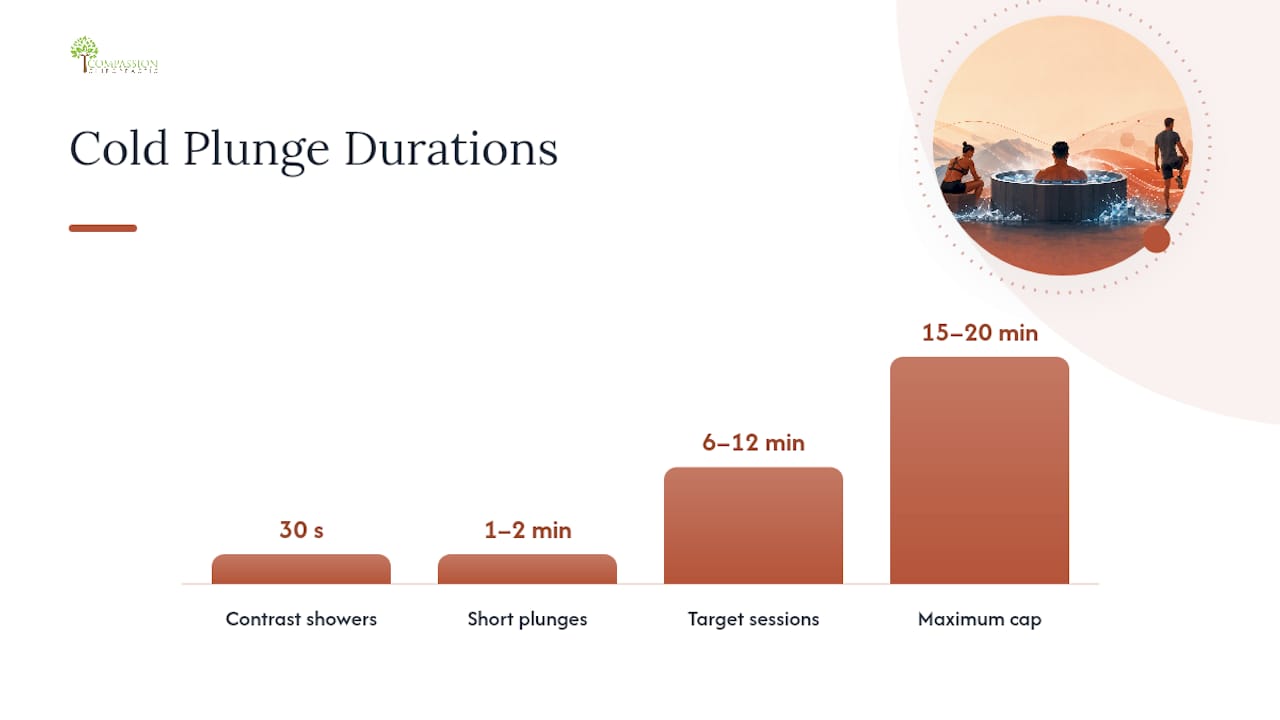
Start with contrast showers. Alternate 30 seconds of cold water with 30 seconds of warm for two or three rounds to acclimate your nervous system.
Move to short plunges. Try one to two minutes at a moderately cool temperature (around 59°F/15°C) for your first few sessions.
Build gradually. Over several weeks, work toward six to twelve minutes at your target temperature as your tolerance improves.
Cap your sessions. Harvard Health’s guidance on cold therapy recommends never exceeding 15 to 20 minutes without direct supervision, regardless of experience level.
Watch for signs that mean it’s time to get out immediately: uncontrollable shivering that doesn’t ease, numbness spreading beyond your hands and feet, dizziness, or any chest tightness. Rewarm gradually afterward with dry clothing and warm (not hot) fluids rather than jumping straight into a hot shower, which can cause a rapid blood pressure swing.
A short checklist before you get in the water: make sure you’re hydrated, avoid plunging on an empty stomach or right after alcohol, and if you’re new to cold immersion, don’t go in alone the first several times. Having someone nearby who can help if you experience unexpected dizziness or a cardiovascular response is a basic safety habit, not an overreaction.
Pro Tip: Set a timer before you get in. The cold makes minutes feel much longer than they are, and it’s easy to either bail too early out of discomfort or, more dangerously, stay in too long because adrenaline is masking how cold you’ve actually gotten.
Who Should Avoid Cold Plunges or Get Medical Clearance First?
Cold water immersion is not risk-free, and the biggest concern isn’t inflammation biology, it’s your cardiovascular system. Sudden cold exposure triggers what’s known as the cold shock response: a rapid spike in heart rate and blood pressure as your body reacts to the temperature change. For someone with healthy cardiovascular function, this is uncomfortable but transient. For someone with existing heart disease or uncontrolled hypertension, it can be genuinely dangerous, which is why medical guidance from major cancer and health centers consistently recommends physician clearance before starting cold plunge practice if you fall into either category.
Cardiovascular disease and uncontrolled high blood pressure aren’t the only contraindications. You should also check with a clinician before cold plunging if you have:
Severe Raynaud’s phenomenon or cold urticaria (a skin reaction to cold exposure)
Peripheral neuropathy, which can mask how cold or numb a limb is actually getting
Concerns related to pregnancy
Certain medications that affect blood pressure, circulation, or temperature regulation
If you experience chest pain, shortness of breath, or fainting during or after a cold plunge, get out of the water immediately and seek medical attention. These are not “push through it” symptoms. The same caution that applies to cardiovascular risk during a cold plunge applies to any strenuous cold exposure, including cryotherapy chambers, since the underlying cold shock mechanism is similar.
This is exactly where a supervised setting earns its value. A clinical environment means someone trained is watching for these warning signs, monitoring your first few sessions, and adjusting the protocol if something about your health history calls for a more cautious approach than a home ice bath would allow.
How to Use Cold Plunges for Recovery, Injury, and Chronic Inflammation
Your goal should shape your protocol. A runner icing sore quads after a marathon needs a different approach than someone managing an acute ankle sprain or a person dealing with chronic joint inflammation.
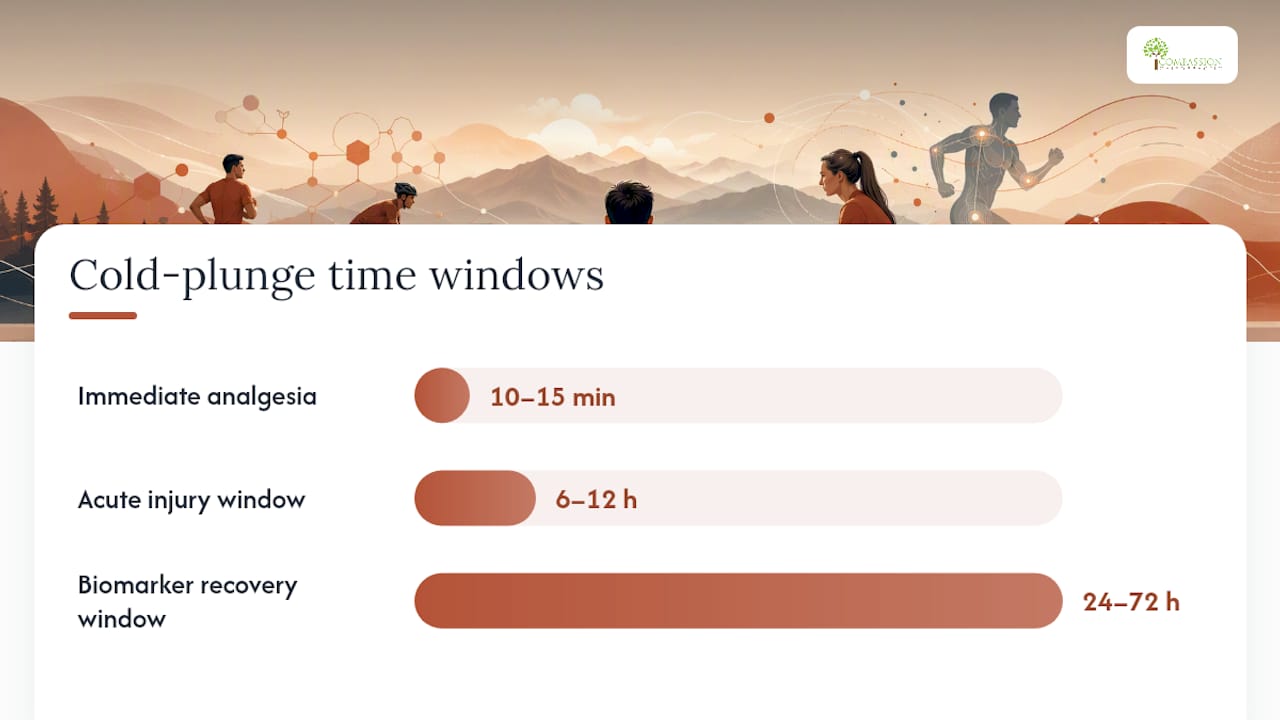
For post-exercise recovery, the timing question comes down to what you’re optimizing for. If you want immediate analgesia, a plunge right after your session at 50 to 59°F (10 to 15°C) for 10 to 15 minutes delivers quick relief from acute discomfort. If your priority is reducing the muscle damage markers that peak days later, spacing cold exposure across the 24 to 72 hour window, rather than only immediately after training, tends to align better with when those biomarkers are actually elevated.
For an acute injury in the first six to twelve hours, cold applied judiciously can help manage pain, following the conservative window outlined in the British Journal of Sports Medicine review. Past twelve hours, the same review cautions that continued cold exposure may interfere with the tissue’s natural healing process rather than support it.
For chronic inflammation, whether from arthritis, an old injury, or a persistent overuse issue, treat cold plunges as symptom management, not a cure. Pairing cold exposure with a clinician-directed treatment plan gives you a far better shot at addressing the underlying issue than cold water alone ever will.
A few practical steps to match method to goal:
Identify whether you’re treating acute pain, delayed soreness, or a chronic condition.
Choose your window: immediate for analgesia, 24 to 72 hours for biomarker-driven soreness.
Layer in complementary approaches like contrast showers, heat later in the healing timeline, active recovery movement, and anti-inflammatory nutrition.
Reassess weekly rather than assuming one protocol fits every phase of recovery.
Cold isn’t the only lever here. Gentle movement, adequate protein intake, and sleep quality all influence inflammation and recovery speed, often more than any single cold plunge session does.
Does Cold Plunging Interfere With Muscle Growth?
Here’s the trade-off that resistance training enthusiasts need to understand: inflammation isn’t purely the enemy. It’s part of how muscle adapts and grows stronger after a hard lifting session. Reporting from National Geographic on the science behind cold plunge claims points out that the vasoconstriction and immediate analgesia cold provides can also blunt some of the adaptive signaling your body needs to build muscle after resistance training.
The practical rule that follows from this: if hypertrophy is your primary training goal, delay cold immersion for at least three to four hours after a strength session, or skip the plunge entirely on your heaviest training days. This gives your body a window to run its natural inflammatory and repair processes before you cool them down. Research on cryotherapy in sports medicine supports this same spacing recommendation for athletes trying to protect strength and size gains.
There are legitimate exceptions. If you’re competing across multiple events in a short window, a tournament weekend, back-to-back competition days, rapid recovery may matter more than maximizing every last bit of hypertrophy signaling. In that context, accepting the trade-off and using cold immediately makes sense. But if you’re in a dedicated training block focused on building strength or size, treat your cold plunge schedule with the same intention you bring to your programming.
Pro Tip: If you lift in the morning and plan to cold plunge the same day, push your plunge to the evening instead of right after your workout. You still get the recovery benefit without cutting into the hours your muscles need to start adapting.
How Chirocompassion Approaches Cold Plunge in a Recovery Plan
At Chirocompassion, cold plunge is never a stand-alone fix. Every recommendation starts with an assessment, because the same soreness in two different patients can have two very different root causes, and cold isn’t the right answer for all of them. Once we understand what’s actually going on, cold plunge often gets paired with other modalities already available on-site, including infrared sauna, red light therapy, and cryotherapy, alongside hands-on rehabilitation work.
We’ve seen supervised cold plunge sessions help patients recovering from overuse injuries who needed short-term relief without masking symptoms they should have been reporting to us. We’ve also seen it help active patients managing training soreness who wanted a monitored environment rather than guessing at home. The difference a supervised setting makes isn’t the water temperature, it’s having someone who understands your history watching how your body responds.
If you’re deciding between an at-home setup and a supervised session, consider what a clinic visit actually adds: a real assessment first, monitoring during your session, and a plan that adjusts as you recover rather than staying static.
— James
Book Supervised Cold Plunge Care With Chirocompassion
Some clinics offer an actual assessment before you get in the water, and a clinician nearby the whole time you’re recovering. If cardiovascular risk, an existing injury, or simple uncertainty about protocol has kept you from trying cold plunge safely, that’s exactly the gap a supervised setting closes.

Our cold plunge tub sessions are offered alongside cryotherapy, infrared sauna, and hands-on rehabilitation care, so your recovery plan doesn’t rely on one modality doing all the work. Supervised sessions tend to benefit people managing cardiovascular risk factors, anyone recovering from a recent injury, and active patients who simply want a clinician watching their response rather than tracking it alone at home. A donation-based model can mean cost is not a barrier to care, and some clinics welcome walk-ins for those who prefer not to wait for a scheduled appointment.
If you’re ready to add supervised cold plunge to your recovery routine, book an appointment online or stop by for a walk-in assessment to talk through what your body actually needs.
Sources
The clinical claims in this guide draw on:
This article is general information, not a substitute for advice from a qualified doctor. Consult a qualified healthcare professional about your own circumstances before acting on anything here.
FAQ
What Is the Fastest Way to Reduce Inflammation After Exercise?
Cold water immersion reduces early inflammatory signaling, particularly IL-6, shortly after exercise, based on the Frontiers network meta-analysis. For muscle damage markers that peak later, whole body cryotherapy showed stronger effects at 48 to 72 hours in that same review.
How Long Should You Cold Plunge for Inflammation?
Most clinical guidance points to sessions of 10 to 15 minutes at 50 to 59°F (10 to 15°C) for post-exercise soreness relief. Beginners should start with one to two minutes and build up gradually, and Harvard Health advises never exceeding 15 to 20 minutes without supervision.
Is Sauna or Cold Plunge Better for Inflammation?
They work differently rather than one being universally better. Cold plunge targets acute inflammatory signaling and pain through vasoconstriction, while heat therapy tends to support circulation and muscle relaxation later in recovery, and many clinics, including Chirocompassion, use both as complementary tools depending on the phase of recovery.
Does Cold Water Actually Reduce Swelling?
Cold water immersion does appear to reduce swelling and certain inflammatory markers in the hours and days after exercise or minor injury, though the effect is modest and time-dependent rather than dramatic. The British Journal of Sports Medicine review cautions that cold is most useful for pain relief in the first six hours and becomes less clearly beneficial after twelve hours.
Can Cold Plunges Interfere With Building Muscle?
Yes, if used immediately after resistance training. Cold exposure right after lifting can blunt some of the natural inflammatory signaling your body uses to adapt and grow stronger, so waiting three to four hours before a cold plunge helps protect those training gains.
Recommended
Comments